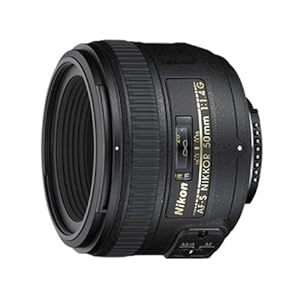
Buy Nikon 50mm f/1.4G SIC SW Prime Nikkor Lens for Nikon Digital SLR Cameras this month to take advantage of these low prices and have your package shipped to you right away.
Your friends will treasure this gift, whether it is for a family member or just for your own enjoyment. It is comforting to have a trusted source to put your trust in. The Nikon 50mm f/1.4G SIC SW Prime Nikkor Lens for Nikon Digital SLR Cameras will prove to be a superb choice.
Thank you for doing business with us for Nikon 50mm f/1.4G SIC SW Prime Nikkor Lens for Nikon Digital SLR Cameras.
Product Description
Manufacturer's Description
Ideal for travel, event, environmental and general photography in a wide variety of conditions, with superb optical formula and an ultra-fast f/1.4 maximum aperture. Fast f/1.4 prime NIKKOR lensPerfect for low-light conditions, general and travel photography. Normal angle of view on FX-format camerasClassic, normal angle of view when used on a Nikon FX-format digital SLR or 35mm film camera. Ideal portrait lens on DX-format camerasAn ideal portrait lens when used on a Nikon DX-format digital SLR, approximating the angle of view similar to that of a 75mm lens on a Nikon FX-format digital SLR or a 35mm film camera. Nikon Super Integrated Coating (SIC)Enhances light transmission efficiency and offers superior color consistency and reduced flare. Exclusive Nikon Silent Wave Motor (SWM)Enables fast, accurate, and quiet autofocus. Close focusing to 1.5 feetFor extended versatility. Rounded 9-blade diaphragmRenders more natural appearance of out-of-focus image elements.
Nikon 50mm f/1.4G SIC SW Prime Nikkor Lens for Nikon Digital SLR Cameras

Product Details
- Product Dimensions: 2.9 x 2.9 x 2.1 inches ; 9.9 ounces
- Shipping Weight: 2 pounds
- Shipping: This item is also available for shipping to select countries outside the U.S.
- ASIN: B001GCVA0U
- Item model number: 50mm f/1.4G
Customer Reviews
This lens is very well-made and takes wonderful pictures. To address the most common questions people ask before they take the plunge:
Price: No, it's not usually this expensive. I paid around $400 for mine, but I got it a couple of months ago. Apparently Nikon is having a hard time making enough of these. Rather than rewarding the greedy opportunists who are now charging exorbitant prices for this lens, I suggest calling local and smaller camera shops - they are much more likely to have one sitting on the shelves. It's absolutely worth about $500, but I wouldn't pay more than that. The Sigma (very similar, see below) is a better value at that point.
Image quality: Great. Slightly soft and glowy at 1.4, but that's to be expected. Gets quite sharp at 2.8. The Sigma is even softer at 1.4 than this lens, so if wide-open sharpness is important to you, this is your lens.
Bokeh: Nice, but a little jittery at 1.4 on specular highlights. This means that if you have any light sources or sharp point reflections in the out-of-focus area behind your subject, you will see little light rings around the round blob. These disappear at f2, and they don't really bother me. They are a side effect of correcting spherical aberration in the image - lens manufacturers have to make tough choices sometimes, and Nikon apparently chose wide-open image correction over the absolute best bokeh possible in this circumstance. Compared to other lenses: not quite as nice as the Sigma 50/1.4 wide open, but you get a sharper in-focus area, so it's a trade-off. Not really able to compete with the 85/1.4 or the 105/2 DC, but that's not surprising - those lenses have a much longer focal length.
Focusing: Fast and precise. To be sure, at 1.4, the depth of field (especially at closer focusing distances) is RAZOR thin, so focusing just isn't possibly going to be spot-on every time. I frequently use manual focus, and even a TINY, TINY nudge on the focus ring moves the plane of sharp focus about one-half inch at those distances, so it's extremely hard to get perfect focus exactly where you want it to be. Be prepared to have some patience, or use live view, if you plan to take close-up shots at 1.4 and you want perfect focus. Most amateurs won't notice if things are slightly out of focus, so not generally a problem unless you're a perfectionist. If you're a constant autofocus user you will not even be aware of this issue. Speaking of up-close focus, I will mention that I feel this lens has a fairly short focusing distance, which is nice - you can really get in nice and tight on subjects and come up with some really attention-getting compositions with neat depth-of-field effects. It's no macro, but I'm constantly amazed at just how close I can get to things.
Low-light performance: Stellar. That's really why I bought this lens, as I already have several amazing lenses for portraiture/bokeh. I love this lens for events where I have room to move around (it's a little long in focal length for tightly-packed spaces) because I hate using flash if it's not necessary. This lens and a slight ISO boost is all you need to take flash-free pictures in many settings.
Build quality: Good. Not like Nikon's professional-grade lenses, but very sturdy - I can't foresee any possible problems. The plastic hood is a twist-on bayonet type, and it works well but can be slightly annoying at times.
Lack of VR: Not a big deal - you shouldn't need VR for a 50mm lens at this aperture; it is easily possible to get to a reasonable shutter speed so that shake isn't a problem. On an APS-C sensor, I'd aim for at least 1/60 second if you want blur-free images. At 1/125 second, you'd have to be going through an earthquake to see any shake with this lens, because it just doesn't have enough focal length to make that a problem. Besides, would you really want to pay $200 more for a 50mm prime? Nikon would have to make this a 1.2 for that to make sense to most people. I think the decision to leave VR off this lens was a good one.
This Nikon 50mm f/1.4G AF-S lens produces sharp pictures and great color and contrast. It is also perfect for portrait and other general purposes (semi-macro etc). This lens also produces nice bokeh. The picture quality and bokeh quality are comparable with the other (older) Nikon 50mm lens which are famous for being sharp. Overall, this is a very versatile lens.
Many of us (including those who already own 50mm f/1.8D AF or 50mm f/1.4D AF as well) have been waiting for this lens for a long time, and overall it is worth the wait, and it is worth the upgrade to this 50mm f/1.4G AF-S. If you don't own any of the earlier version of the 50mm lens then you should definitely get this lens over the older 50mm non-AFS lens (especially if price is not much of a factor for you or if your camera body is a D40, D40x, or D60 which the autofocus with will work with those cameras as well).
Some of the limitations of this lens are similar to the other 50mm lenses (but some big benefits are added in this lens):
First, being a prime lens, you will need to move your feet a lot to compose your picture. If you are used to zoom lens, don't underestimate this limitation. It takes me a while to get used to it, and sometime I still find people looking at me wondering why I am moving forward and backwards. the good news is that most of the time, they don't think I'm weird, but they are actually wondering if I'm a professional photographer.
Secondly, the focal range of 50mm, which is considered the normal lens and great for portrait lens. but on many DSLRs which is not full frame (unless you have a full frame Nikon DSLR like the D700 or D3, then 50mm is 50mm), this lens become a 75mm equivalent which is in the border of a short tele lens. I actually like the 75mm equivalent though I often have to move backwards when taking picture of a group of people.
While this lens produces very sharp images at f/1.4, the corner show lower contrast. Sharpness and contrast increases further as you stop down to f/2, f/2.8 and f/4.
The big plus with this lens over the older 50mm lens is the AF-S feature which is auto focus system that is internal to the lens, very fast and very silent. This lens will please a lot of people who currently own D40, D40x, and D60, as they now can benefit from the autofocus.
Another big win is the manual override on autofocus mode (M/A mode), which will allow us to change the focus without having to change the mode to manual mode (this is pretty standard to most Nikon newer lenses but it's a first for the Nikon 50mm lens series)
I'm a bit surprised that Nikon didn't include VR in this lens since they add VR to many of their newer lenses including some of wider angle lens (e.g the 16-85mm, and the 18-55mm) which would be perfect when taking handhelds shots during low light environment (like concert, indoor sports, etc). And the price (current price) will be perfect too if this lens have a VR feature (otherwise it is a bit expensive).
If you are wondering whether you should get a fast lens or a lens with VR (Vibration Reduction), here's my take: In overall, VR does help a lot (as it will reduce camera shake) and will produce better/sharper picture than equivalent lens without VR (especially if the object is static). If the object is moving fast (sports/action) then VR feature alone might not help (depending on how fast the object is moving and how much light is available), and a fast lens often end up being a far better solution, even without VR feature as it will allow much faster shutter speed to freeze motion. Using tripod (and a remote) will substitute for the need of VR feature. In general I would recommend getting a fast lens with VR feature (and usually it is expensive) such as the 70-200 f/2.8 VR, but if one can only get for one or the other, then find out what do you want to use the lens for and then use the guideline mentioned here.
If you are wondering whether you will get the benefit of buying f/1.4 lens over a f/1.8 lens, just remember that the f/1.4 lens is about 60% faster than f/1.8 at its widest aperture setting. With this information, you can decide if the additional speed will justify the additional cost. The bokeh is nicer as well in f/1.4 lens but I think speed is usually the main factor in deciding whether to get the more expensive f/1.4 lens.
Here are the summary of pros and cons for this Nikon 50mm f/1.4G AF-S lens:
Pros:
1. AF-S AF-S AF-S (very fast focus, internal focus, and very silent)
2. M/A mode (manual focus override available on autofocus mode)
3. Very fast lens (f/1.4)
4. Very sharp pictures
5. Great for sport/action photography
6. Great for indoor and low light situation
7. Great for portrait
8. Bokeh is almost as good as many expensive Nikon tele-lens
9. Perfect for wedding photography (or low light with no-flash event). However, also check out the following lens for wedding photography (17-35mm f/2.8, 24-70 f/2.8, 17-55mm f/2.8, 28-70mm f/2.8 or the other two 50mm nikon prime lenses)
9. 75mm equivalent which can be considered a short tele lens (If you need more zoom, you can get the Nikon 85mm f/1.8, 85mm f/1.4 or the 70-200mm f/2.8 VR). If you have full frame DSLR(like the D3 or D700), then this 9 pros is not applicable.
10. Did I mention very fast and very silent focus?
Cons:
1. Being prime lens, you need to move your feet a lot to adjust/compose
2. Being a G lens (no aperture ring available), this lens will not work on manual focus camera where you need to set the aperture from the lens)
3. Price is a bit on the high range for a prime lens
4. No VR. As VR will be useful for taking handheld shots on low light (especially if the object is somewhat static or if the photographer doesn't have steady hands when taking photograph)
5. 75mm equivalent with 1.5x multiplier on non full frame DSLR (many people find this is an odd range for normal lens). If you have full frame DSLR(like the D3 or D700), then this 5 cons is not applicable.
Bottom line: This lens is so versatile that I think everyone should own this lens (or at least one of the other 50mm lenses) in addition to all the lenses that they already have. Being a very fast lens, it will allow people to take action shot in low light that otherwise wouldn't be able to be do. And now, with AF-S, there is nothing to dislike about this lens (though in my opinion, this lens might attract even more interest if it has a VR feature).
Happy Photographing!
Sidarta Tanu

No comments:
Post a Comment