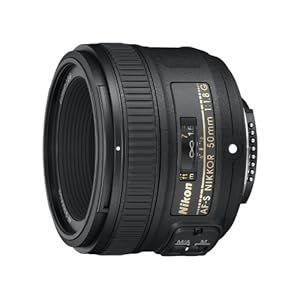
Right now you are searching for Nikon 50mm f/1.8G AF-S NIKKOR Lens for Nikon Digital SLR Cameras. Purchase this item and anything else you require in terms of all your needs. For secure and reliable service, shop right here at here.
Product Description
From the Manufacturer
Fast f/1.8, compact FX-format prime (fixed focal length) lens Optimized for FX-format D-SLR cameras but equally at home on any Nikon DX-format D-SLR, this updated classic with a fast maximum aperture is ideal for everyday shooting, perfect in low lighting situations and great for producing images with beautiful background blur (bokeh). The AF-S 50mm f/1.8G includes Silent Wave Motor technology (SWM) for fast and precise autofocus, M/A Focus Mode Switch for seamless changes between manual and autofocus operation and an aspherical lens element for outstanding optical performance with high contrast.
Sample Photography
Stunning depth of field.
Brilliant low light results.
Tack-sharp portraits.
Features:
Nikon Silent Wave MotorA significant innovation in AF lens technology, Nikon's Silent Wave Motor uses ultrasonic (inaudible) vibrations—rather than a gear system—to focus the lens, providing incredibly smooth, silent and precise autofocus operation.
M/A Focus Mode SwitchWhen fine manual focusing is needed, simply rotate the lens focus ring—M/A mode allows you to seamlessly override the AF system with virtually no time lag.
Aspherical Lens ElementSince the 1960s, aspherical lenses have been an important part of the NIKKOR lens family. Virtually eliminating coma and other types of aberration, every new addition to the lineup provides a new level of contrast, resolution and compact design.
Super Integrated CoatingNikon's Super Integrated Coating enhances light transmission efficiency and offers superior color consistency and reduced lens flare.
How to read the MTF curve chart
Lens Construction
Price : $219.00
You Save : $0.95

Product Details
- Item Weight: 6.6 ounces
- Shipping Weight: 8 ounces (View shipping rates and policies)
- Shipping: This item is also available for shipping to select countries outside the U.S.
- ASIN: B004Y1AYAC
- Item model number: NIKKOR 50mm f/1.8G AF-S
Price : $219.00
You Save : $0.95
Customer Reviews
Review of the Nikkor 50mm f/1.8G AF-S versus other Nikkor 50mm AF lenses
This quick review is based on my use of this lens for almost 3-weeks. It is intended for those already familiar with Nikkor's line of 50mm prime lenses but are wondering how this lens compare with the other Nikkor 50mm autofocusing lenses that I also own. I did however provide a section for beginners or novice at the last section of this review.
AGAINST THE NIKKOR f/1.8D
The Nikkor 50mm f/1.8G is slightly bigger than the Nikkor 50mm f/1.8D and a bit heavier but by a mere 31 grams, hardly noticeable at all. Unlike the 50mm f/1.8D, it comes with a reversible hood which does a good job in protecting and shading the lens. Unlike the 50mm f/1.8D which uses a 52mm filter, this lens uses a 58mm filter. Unlike the 50mm f/1.8D which has a maximum aperture of f/22, the maximum aperture of this lens is f/16 (as do the Nikkor 50mm f/1.4D and 1/4G). As the "G" suffix indicates, the 50mm f/1.8G does not have an aperture ring while the 50mm f/1.8D has an aperture ring (see notes below for the significance of this).
The new Nikkor 50mm f/1.8G is sharper and has better bokeh. The aspherical element in the new Nikkor 50mm f/1.8G has further improved the acuity of this lens specially noticeable at the corners even at its wide-open setting. Yet Nikon also improved the bokeh of this new lens versus the 50mm f/1.8D! I also noticed some slight improvement in the color and contrast, specially when shot from f/2.0 and above. Focus speed is decently fast and is about the same on a Nikon DX D7000 yet the 50mm f/1.8G seems to be more consistently precise and significantly quieter. Priced very reasonably, this 50mm f/1.8G lens also now focuses on Nikon bodies without built-in focusing motors such as the Nikon D3000, D3100, D5000, D5100, D40, and D60. Focus speed is decently fast. This lens is a winner by a clear margin!
As the price of the 50mm f/1.8D has risen in the recent months, the price disparity between this lens (USD$219.00) and the Nikkor 50mm f/1.8D has narrowed. Considering that the 50mm f/1.8G has better optical performance (sharper, better bokeh, improvement on color and contrast), has an included hood, lens pouch, plus the flexibility of being able to use this lens with all of Nikon's dSLR, I strongly recommend anyone looking for a Nikkor 50mm f/1.8 lens to choose this Nikkor 50mm f/1.8G over the Nikkor 50mm f/1.8D.
AGAINST THE NIKKOR 50mm f/1.4D
The Nikkor 50mm f/1.8G is slightly bigger than the Nikkor 50mm f/1.4D but is lighter by 63 grams. Unlike the 50mm f/1.4D, it comes with a reversible hood which does a good job in protecting and shading the lens. Unlike the 50mm f/1.4D which uses a 52mm filter, the 50mm f/1.8G uses a 58mm filter.
At the same aperture setting from f/1.8 and above, the new Nikkor 50mm f/1.8G is again sharper and has better bokeh. This is surprising considering that the 50mm f/1.4D is already stepped down 2/3 of a stop when these two lenses are compared at the same aperture setting. The bokeh of the 50mm f/1.8G is also better! Focus on the 50mm f/1.8G seems about the same or just a bit faster than the 50mm f/1.4D on a Nikon DX D7000 but the difference is so small as to be almost imperceptible. Focus precision between these two lenses are about the same but the 50mm f/1.8G focuses quieter than the 50mm f/1.4D.
The primary advantage of the 50mm f/1.4D over this lens is primarily in it being 2/3 of a stop faster and it having an aperture ring. The former is important for still photography while both are important for video where 2/3 of a stop advantage and being able to manually set the aperture have a substantial impact on the final output. The 50mm f/1.4D remains attractive for these. For still photography shooting at f/1.8 and above, I would choose the 50mm f/1.8G over the 50mm f/1.4D.
AGAINST THE NIKKOR 50mm f/1.4G
In terms of size, this lens is about equal with the Nikkor 50mm f/1.4G and also uses the same 58mm filter. The 50mm f/1.8G is lighter by 94 grams than the 50mm f/1.4G. Like the 50mm f/1.4G, it comes with a very useful hood.
At the same aperture setting, the new Nikkor 50mm f/1.8G is as sharp in the center and has about the same quality of bokeh. The 1.4G of course would have a better bokeh shooting at f/1.4 and f/1.6 still than the 1.8G at f/1.8. More noticeable is that the 50mm f/1.8G is sharper at the corner than the 50mm f/1.4G when shot wide-open. This is surprising considering that the 50mm f/1.4G is significantly better than the 50mm f/1.4D yet the 50mm f/1.8G is still a bit sharper beginning at f/1.8 but even more noticeable at f/2.0 despite the 50mm f/1.4G being already stepped down! Measured in terms of optical performance alone, the 1.8G has a slight advantage over the 1.4G in corner acuity even at f/1.8 but more so at f/2.0 and above. Color and contrast are about equal and I am unable to see any difference between the two. It would seem that the aspherical lens element that Nikon added to the 1.8G but not to the 1.4G has made quite a considerable difference. Yet Nikon also endowed this lens with excellent bokeh despite it being half the price. Kudos to Nikon for doing this!
In terms of focus precision, the 1.8G does not differ much from the 1.4G on my Nikon D7000 and D3100. In terms of focus speed, the 50mm f/1.8G focuses a tad faster than the 50mm f/1.4G. Manual focusing on the 50mm f/1.4G however is easier than on the 50mm f/1.8G. This may be an important consideration when choosing a lens for video use.
Like the 50mm f/1.4D, the primary advantage of the 50mm f/1.4G is its being faster by 2/3 of a stop which can be invaluable for still photography and for video as well for those aiming for the thinnest depth of field (DOF) and/or more light to keep the ISO setting as low as possible. For these advantages, the 50mm f/1.4G cost about double the price of this lens.
If only Nikon included nano-coating and added an aspherical element into the 50mm f/1.4G to make it perform like or perhaps better than the 50mm f/1.8G, then the extra cost of the 50mm f/1.4G would be easier to justify and the 1.4G would be a clear choice. But as it stands, one would choose the 1.4G when shooting at f/1.4 to f/1.6. But when shooting at f/1.8 and above, the 1.8G would be a better and also a less expensive choice (at just half the price).
NOTES RE THE 50MM AND VIDEO-ENABLED NIKON DSLRS:
The 1.8G like the 1.4G no longer has an aperture ring that the 1.8D and the 1.4D still retained. The aperture ring remains handy and useful for manual control of aperture in video more so as the current video-enabled Nikon dSLRs do not allow the changing of aperture settings when video recording has started. With an aperture ring, the aperture setting can be changed manually once video recording has started.
ADDITIONAL NOTES OWNERS OF THE NIKKOR 35mm f/1.8G
The Nikkor 50mm f/1.8G is slightly bigger and slightly heavier than the Nikkor 35mm f/1.8G but the weight difference is not really noticeable. The 50mm f/1.8G exhibit the same qualities as the Nikkor 35mm f/1.8G in that it is usable and sharp even when shot wide-open. These two lenses are also priced about the same. While the Nikkor 35mm f/1.8G is a DX lens, I have used it with an FX body at night where the vignetting at the corners is not as issue as it is not noticeable under certain light conditions. I would not however use the Nikkor 35mm f/1.8G on an FX body on daytime or where the light is even. Sharpness at the corner is also not good. The Nikkor 50mm f/1.8G can be used with a DX body as well as with an FX with no vignetting or corner sharpness issue such as I described. Like the Nikkor 35mm f/1.8G, color and contrast improves considerably when this lens is stepped down a bit by 1/3 to 2/3 stop. If you own a Nikkor 35mm f/1.8G and need the field of view of this lens, getting this lens would be a no-brainer.
SUMMARY
In sum, this lens is currently the best Nikkor 50mm lens for general still photography when shooting from f/2.0 and above. The stellar performance of this lens matched with its relatively low price and its ability to autofocus on Nikon's lower model dSLRs makes it a hands-down winner.
For still photography or video where every little bit of light is needed or where getting the thinnest DOF is crucial, the Nikkor f/1.4D and f/1.4G remains the better choice. The Nikkor f/1.4D with its aperture ring is particularly useful for video with its ability to change the aperture setting through the aperture ring even after video recording has started. Changing the aperture setting after video recording has started is currently not possible with the Nikon D7000 and the Nikkor 50mm f/1.4G. This situation makes it necessary for me to own multiple type of Nikkor 50mm lenses.
FOR THE NOVICE OR BEGINNER
This lens is light, compact inexpensive, but produces very impressive results. On a DX body such as the Nikon D40, D60, D3000, D3100, D5000, D5100, D7000 and D300(s), this lens has a field of view of a 75mm. On an FX body such as the Nikon D700, D3(s) or D3x, this lens has a field of view of a 50mm.
Despite it being a fixed focal length and not being able to zoom, I highly recommend this lens for beginner Nikon dSLR users who own only the kit zoom lens. This prime lens is a safe, inexpensive, and exceptional route to trying out how good a prime lens can be as against zoom lens. In addition, this lens allows you to shoot at low light and/or to blur the background of the subject of the photo. It also hints at what the professional Nikon zoom lens are capable of should you get serious in this hobby. This lens is very compact and easily packed in the bag for those times when a wide open lens is needed for shooting in low light conditions.
I absolutely love this lens. This lens has not come off my D3100 since I bought it 3 weeks ago. My primary purpose for buying this lens was to take portrait pictures indoors of my 2 year old son. I found that with using the kit lens, I still had to use the flash at times even with a high iso. That's when I started researching new lenses.
I chose the new 50 mm lens due to its low light capabilities. This lens does such an amazing job that I have not used the flash at all since. It is important however to switch the white balance settings when moving from indoors to outdoors. I love how this lens is able to blur the backround, so much more than the kit lens could. I initially bought the d3100 to take better pictures than a point-and-shoot could, I feel that this lens has made a similar step-up from the kit lens.
All in all, I can't see myself using the kit lens again. I easily got used to moving around a lot to take pictures, but when you're trying to focus in on a active 2 year old, you're used to doing that anyways. The investment truly is worth it in my opinion, especially if you're trying to capture those priceless moments.

No comments:
Post a Comment