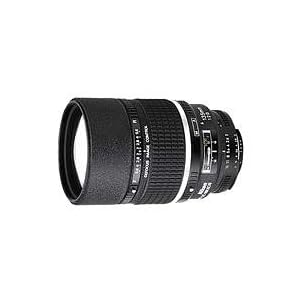
Buy Nikon 135mm f/2.0D AF DC-Nikkor Lens for Nikon Digital SLR Cameras this month to take advantage of these low prices and have your package shipped to you right away.
Your friends will treasure this gift, whether it is for a family member or just for your own enjoyment. It is comforting to have a trusted source to put your trust in. The Nikon 135mm f/2.0D AF DC-Nikkor Lens for Nikon Digital SLR Cameras will prove to be a superb choice.
Thank you for doing business with us for Nikon 135mm f/2.0D AF DC-Nikkor Lens for Nikon Digital SLR Cameras.
Product Description
This high-performance, medium telephoto features Defocus Image Control allowing for control of the degree of focus in the foreground or background.
Price : $1,195.00

Product Details
- Product Dimensions: 4.7 x 3.1 x 3.1 inches ; 2 pounds
- Shipping Weight: 2 pounds (View shipping rates and policies)
- Shipping: This item is also available for shipping to select countries outside the U.S.
- ASIN: B00006I5J4
- Item model number: 1935
Price : $1,195.00
Customer Reviews
This lens is not just a specialty 'portrait lens' but a superb piece of optical excellence from Nikon, and a lens that you can buy now and use for an entire career or lifetime of photography. It is among Nikon's sharpest lenses ever produced, with sharpness exceptional even wide open at f/2 in the corners. Autofocus is extremely fast on a D300 or D700. At f/2 the bokeh is gorgeous, close to that of the famed 85mm f/1.4, but more interesting as the 'defocus control' (not a good term for the actual function but Nikon's choice) allows you to do the following things:
- leave it at the same aperture at which you are shooting (i.e. if you're shooting at f/2 or f/2.8, then set the DC ring at f/2, or f/2.8 in either direction) to get beautiful bokeh and a sharp subject; in this case, your bokeh will be more pronounced either behind or in front of your subject (assuming there are things in front of the subject which are out of the depth of field or focal subject). An example: a row of flowers in a garden in front of the subject, with focus on the subject set, and shooting aperture of f/2.8 = setting the DC at f/2.8 "F" ("front") causes the flowers in front of the subject to have 'more bokeh' than normal, whereas setting it at "R" ("rear") causes the same for the rear row of flowers (although this is a bit harder to see unless you're at narrower apertures where you usually don't get that much creamy bokeh).
- set it beyond or below the aperture you are shooting, to gradually 'defocus' the subject that is already in focus. Now this sounds like anathema to anyone who wants "sharp" photos from lenses (as "sharpness" is one of the big selling points) but for portraits specifically, a tack-sharp shot is in fact not always what you might want. For older, more 'mature' subjects which may have the various blemishes, wrinkles, lines, etc. which would be very pronounced and distinct in a tack-sharp lens' focus, a slight change of the DC ('defocus control') ring allows for the ever so slightest (at one stop different from your shooting aperture) to a much more soft 'defocus' of the subject. In other words, if you're shooting at f/2.8, setting the DC at f/3.5 or more (either "F" or "R" - I found "R" to be a bit nicer) will gradually place the subject of the portrait ever so slightly out of focus - or 'soft' focus, as the old lenses and filters would create - and make the subject very attractive without any of the unwanted details that one wouldn't want in a portrait enlarged to, say, 11x14 or whatever size.
The wide f/2 aperture allows for beautiful bokeh and tack-sharp shots without manipulating the DC ring, if you're not interested in 'soft' focus, and the f/2 aperture is exceptional for low light photography, whether at night, indoors or outdoors, or in a low-light setting such as a theater, sporting event indoors or outdoors, etc.
Some say this lens is 'hard to use' because of the DC ring; once you take a few sample shots with it and experiment with one subject, you'll start to get a feel for the types of settings that you find most pleasing, and use those in the field. Or, you can just not change the DC ring at all and enjoy the extreme sharpness, superb bokeh and extraordinary color rendition from this ultra-pro-quality lens.
The construction is solid, tank-like and built to last a photographic lifetime; the price is not trivial, but it is about right for this level of lens, and as a one-time investment, it's justifiable given the shots you will get from it. There is no VR, of course, so it's important to use good technique to get the sharpest shots (i.e. try to limit camera shake, use fast shutter speeds, etc.) at this 135mm focal length. On a DX camera the focal length converts to about 200mm so this is superb for portraits outside (basically at the same length as the non-DX 200mm f/2 pro lens which sells for $5k). However, the long focal length means that the slightest camera shake at slower shutter speeds may impede sharp photos; I try to stay at 1/100 or faster when handheld to avoid this (and in low light, the f/2 wide open will allow that if you have your high ISO set on a newer model that gives usable images even at ISO6400). Now on a tripod for portraits this lens has to be best in its class; the difference between the 85mm f/1.4 may be only 50mm in focal length, but the effects that this lens can produce with some judicious use of softening the subject's focus really stand out in enlarged shots, particularly those of weddings, etc. where tack-sharp isn't always the aim, and even a slightly "dreamy" or "romantic" mood is the goal. It focuses quite close for this focal length and aperture, so both head-shot-only close-ups and head-and-shoulders portrait shots from farther away (even full body shots, if you're far enough) are possible. It's nice as a medium telephoto or quasi-macro lens outside, as well, for flowers and other nature shots, as the focal distance works well.
Ergonomics: excellent. The built-in hood is a little clumsy but very convenient, and doesn't ever get in the way. The weight is perfectly balanced and feels terrific on my D700. The rubber focus ring doesn't move when focusing, and is perfect to grip with the left hand (assuming a right-handed camera shooter). There is no case included with the lens in the box, but a Nikon soft lens bag for $15 or so is a good investment - get a big one like the CL-S2, as this lens is rather large (not much smaller than the 70-300mm VR). The recommended nylon hard case is a bit bulky and not really necessary if you already have a camera bag or backpack that holds a few lenses - just get the soft case to protect it from scratches, etc. inside that bag.
With everyone giving steller reviews about this lens, I want to talk a little about what this lens is not. I have tried this on a variety of bodies, and they all produce exceptional pictures. On DX body and therefore 200mm equivalent, it's pretty fast considering its size but it doesn't really shine because there are other options. On FX body, it creates a very unique partnership.
I believe there is certain myth about the Defocusing Control feature. I had tested the effects on bokeh in very controlled environment and frankly unless I am blowing up a 12MP photograph to 100% crop, I cannot tell much of the difference! This doesn't mean it is useless, but I misled myself when I first acquired the lens thinking it can turn a rather unavoidable harsh background into swirled soft ice cream. Of course, the soft focus works well, but honestly there are so many ways to make a picture "soft" do I really need to spend $1000+ on a lens for that effect? Marketing people make me cry sometimes. To me, the DC feature is worth about $50...
However even if I ignore the DC ring for a second, this lens produces beautiful and sharp photos. I pretty much own all of Nikon's best lens line-up (in the similar class I have 85mm 1.4, Carl Zeiss 85mm 1.4, 50mm 1.4, and all the constant aperture 2.8s). Yet when I have a special occasion and the distance I need to work with I will always pack this lens with me. It renders beautiful colors, and creates ultra-sharp subjects (that are in focus of course). The AF speed is respectable and the accuracy is dead-on. I rarely shoot at 1.4 unless I am indoors with very low light, so to me this f2 lens is perfect for me.
I always recommend this to people if they are uncertain whether they will like a certain prime lens. Just take a cheapo zoom lens and set it to the length you wish to evaluate and fix it there. Shoot around all day and see if you can get used to the length and the working space. 135mm is an odd length, therefore one may find it inconvenient. However, I don't think anyone on this planet can argue about the quality of pictures this lens produces.

No comments:
Post a Comment