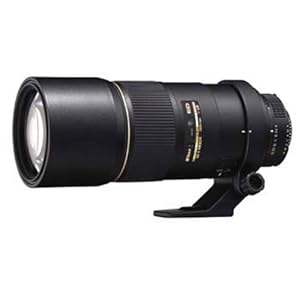
Today is the right time to get this as a gift. You are going to like this extremely popular Nikon 300mm f/4.0D ED-IF AF-S Nikkor Lens for Nikon Digital SLR Cameras and its slashed price. Don't miss it - get the Nikon 300mm f/4.0D ED-IF AF-S Nikkor Lens for Nikon Digital SLR Cameras here now!
Product Description
Manufacturer Description
Lens-making is an art--Nikon artisans craft Nikkor optics from the finest materials, taking pride in adding their intellect and technique to bring the world's finest lenses to life. They push the leading edge of lens-making in their effort to provide the "glass" that makes the world's greatest pictures.
AF Nikkor lenses work with Nikon SLRs for optimal performance, even the very latest. The Nikon 300mm f4D IF-ED AF-S is a compact super-telephoto lens for travel, sports, wildlife and stock photography. It is a super fast, super quiet lens using Silent Wave motor technology, with ED glass elements for high-resolution and high-contrast images. It features a 4.8-foot closest focusing distance, M/A mode that allows rapid switching between autofocus and manual operation, and a nine-blade rounded diaphragm that achieves a natural blur for out-of-focus elements.
ED glass: An essential element of Nikkor telephoto lensesNikon developed ED (Extra-low Dispersion) glass to enable the production of lenses that offer superior sharpness and color correction by minimizing chromatic aberration. Put simply, chromatic aberration is a type of image and color dispersion that occurs when light rays of varying wavelengths pass through optical glass. In the past, correcting this problem for telephoto lenses required special optical elements that offer anomalous dispersion characteristics--specifically calcium fluoride crystals. However, fluorite easily cracks and is sensitive to temperature changes that can adversely affect focusing by altering the lens' refractive index. So Nikon designers and engineers put their heads together and came up with ED glass, which offers all the benefits and none of the drawbacks of calcium fluorite-based glass. With this innovation, Nikon developed several types of ED glass suitable for various lenses. They deliver stunning sharpness and contrast even at their largest apertures. In this way, Nikkor's ED-series lenses exemplify Nikon's preeminence in lens innovation and performance.
Nikon Super Integrated Coating ensures exceptional performanceTo enhance the performance of its optical lens elements, Nikon employs an exclusive multilayer lens coating that helps reduce ghost and flare to a negligible level. Nikon Super Integrated Coating achieves a number of objectives, including minimized reflection in the wider wavelength range and superior color balance and reproduction. Nikon Super Integrated Coating is especially effective for lenses with a large number of elements, like our Zoom-Nikkors. Also, Nikon's multilayer coating process is tailored to the design of each particular lens. The number of coatings applied to each lens element is carefully calculated to match the lens type and glass used, and also to assure the uniform color balance that characterizes Nikkor lenses. This results in lenses that meet much higher standards than the rest of the industry.
Internal FocusingImagine being able to focus a lens without it changing in size. Nikon's IF technology enables just that. All internal optical movement is limited to the interior of the non-extending lens barrel. This allows for a more compact, lightweight construction as well as a closer focusing distance. In addition, a smaller and lighter focusing lens group is employed to ensure faster focusing. The IF system is featured in most Nikkor telephoto and selected Nikkor zoom lenses.
Distance informationD-type and G-type Nikkors relay subject-to-camera distance information to AF Nikon camera bodies. This then makes possible advances like 3D Matrix Metering and 3D Multi-Sensor Balanced Fill-Flash. Note: D-type and G-type Nikkors provide distance information to the following cameras: Auto exposure; F6, F5, F100, F90X, F80, F75, F70, F65, F60, F55, F50, Pronea S, Pronea 600i, D2 series, D1 series, D100, and D70s/D70. Flash control; F6, F5, F100, F90X, F80, F75, F70, D2 series, D1 series, D100, and D70s/D70 cameras.
Silent Wave MotorNikon's AF-S technology is yet another reason professional photographers like Nikkor telephoto lenses. AF-S Nikkors feature Nikon's SWM which converts "traveling waves" into rotational energy to focus the optics. This enables high-speed autofocusing that's extremely accurate and super quiet.
M/A modeAF-S Nikkors feature Nikon's exclusive M/A mode, that allows switching from autofocus to manual operation with virtually no time lag--even during AF servo operation and regardless of AF mode in use.
What's in the Box:Lens, 77mm snap-on front lens cap, rear lens cap LF-1, semi-soft case CL-M2.
This high-power 4.3x telephoto zoom is a versatile and lightweight answer to bringing family action closer. Fits all Nikon SLR cameras but optimized for automatic-focus models
Price : $1,369.95

Product Details
- Product Dimensions: 8.8 x 3.5 x 3.5 inches ; 4.5 pounds
- Shipping Weight: 5 pounds (View shipping rates and policies)
- Shipping: This item is also available for shipping to select countries outside the U.S.
- ASIN: B00005LEOM
- Item model number: 1909
Price : $1,369.95
Customer Reviews
I'm surprised that there are so few reviews for this lens.
I wanted a telephoto for years so I bought an old used manual focus Nikon 300mm f4 lens. I was able to get good sharp photographs when shooting outdoors in bright sunshine with the aperture closed down a few stops. But without the split prism focusing in less than very bright environments, I was never certain when I was in focus except by looking at the green dot in the viewfinder which is distracting while trying to keep your eye on a moving subject. Auto-focus is a must on a big telephoto.
I traded it in (the advantage of buying from a local camera store) and bought a new Nikon 300mm f4. Before leaving the store, I photographed a few items inside the store that had bar codes. I photographed hand held with the aperture wide open at about 1/100 second. I zoomed in on my D300 LCD and I could clearly read the tiny numbers at the bottom of the bar codes. The images were perfectly sharp.
I ponied up an additional $1K and bought it. Hey, it was my wedding anniversary and my wife asked what I wanted; this was it. I then took another series of photographs of a sharp barcode on a bottle. This time, I used a tripod for consistency. I do this test with each lens I buy. The only other lens that had this quality as the Nikon 85mm f1.4.
I could see no difference in sharpness or contrast regardless of aperture. I then photographed a house for sale sign up the street. The lens quickly and quietly locked in on the sign. Again, zooming in all the way on the camera's LCD, I was able to easily read the very tiny print at the bottom of the sign (at 200 ISO).
The lens is fairly lightweight so I didn't have any problem hand holding it. It weighs about the same as the Nikon Micro 2.8 lens (not sharp wide open). I don't think I could have held the 300mm f2.8 lens for very long.
Because the lens isn't heavy, by holding the lens hood with one hand and having a good body stance, I was able to take good shots as low at 1/100th of a second. Some photographers claim their photographs were taken hand-held as slow at 1/20 of a second but I find that hard to believe.
While the f4 model doesn't have VR (I love VR) and is only 1 fstop slower than the nearly $6K f2.8 300mm lens, it's about 1/4th of the price of the 2.8 and weighs 1/2 has much (3 pounds vs. 6 pounds). On a Nikon D300/D700 with a battery pack or a D3/D3s, carrying around a 300mm 2.8 lens has got to hurt after awhile.
One review described the f4 model as a "poor mans lens". I hand hold my lens with either a D3s or a D300 ; battery pack since the subjects move too erratically to use any type of support. Let me tell you, the weight aches after awhile. I can't imagine adding an additional 3 (THREE) pounds. The f2.8 model is meant to be hand held otherwise why have VRII? I pity the poor man that has to hand hold the 6 pound lens for more than a few minutes.
Yes, the 2.8 lens is one stop faster and the VR will give you an extra 2-4 stops, but with an FX body I found you can crank up the ISO to at least 3200 or 6400 with no degradation in picture quality. Unless you have very challenging light situations, the f4 300mm model may be the perfect lens.
The only negative aspect of this lens is that under very low light situations with a 1.7 teleconverter, the lens has to hunt. I have to manually focus then press the shutter so that auto-focus kicks in.
I love the 5 year warranty (I send in the warranty card via Certified Mail -- you only have 10 days so mail it in quickly) and I scan the filled in warranty registration card and proof of purchase). Nikon just fixed, for free; not even any shipping costs, my broken 18-200mm gray market lens that was about 2 years old.
[May, 2010 update: Some people have told me that Nikon no longer will fix a gray market Nikon lens]
Lens actually comes with a decent soft case.
I don't understand why other reviewers have complained about the tripod collar. It seems perfectly good to me. It's not solid metal like the old manual focus lens that I returned but it looks rugged enough for me.
I tend to be very fussy; perhaps to a fault. It's my personality. I wind up returning or exchanging many (most?) items that don't live up to my expectations. But, I'm definitely keeping this puppy.
Some friends came over one night and they brought their young daughter who didn't like being photographed (2 year olds tend to be cranky especially when they're tired). I used the 300mm lens on a DX body so that she didn't have a camera in front of her face; I was about 10 feet away. Since all I had was a few house lamps on, I had to photograph at wide open at f4. I was surprised that every single eyelash was tack sharp. The lens had no problem auto-focusing in the dim light. What a lens!
This is a superb lens, without the bulk or the much higher cost of the f/2.8 version. With the money you'll save, you can buy a replacement tripod collar for the lens from Kirk Enterprises, which is a vast improvement over the somewhat flimsy collar which comes with the lens.

No comments:
Post a Comment