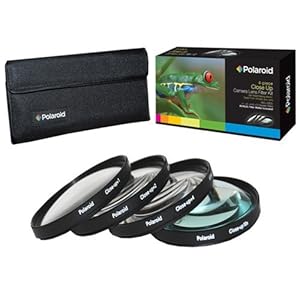
Today is the right time to get this as a gift. You are going to like this extremely popular PLR Optics +1 +2 +4 +10 Close-Up Macro Filter Set with Pouch For The Nikon D5000, D3000, D5100, D3100, D7000, D4, D800, D800E Digital SLR Cameras Which Have Any Of These (18-55mm, 55-200mm, 50mm) Nikon Lenses and its slashed price. Don't miss it - get the PLR Optics +1 +2 +4 +10 Close-Up Macro Filter Set with Pouch For The Nikon D5000, D3000, D5100, D3100, D7000, D4, D800, D800E Digital SLR Cameras Which Have Any Of These (18-55mm, 55-200mm, 50mm) Nikon Lenses here now!
Product Description
PLR filters continue the brand's long legacy of superior optical solutions. All our filters are carefully formulated to ensure consistent color and accuracy throughout the entire surface of the glass. Why? Consistent color means consistent high quality results. We know that a poorly made filter makes a great lens and camera worthless, that's why the our frame rings are constructed of special alloys that won't expand or contract over time or due to temperature extremes-it's also why we back our filters with an 10 year warranty-because we engineer them to last. Like all OUR optics, filters are precision manufactured to the most demanding of tolerances. This ensures consistent high quality results even after years of use.
Price : $12.03

Product Details
- Item Weight: 0.3 ounces
- Shipping Weight: 2 pounds (View shipping rates and policies)
- ASIN: B002P9HXMW
- Item model number: 3PCLENS-63
Price : $12.03
Customer Reviews
While I have not used all of the diopters in the kit, I have used the +1 and +2 attachments. They are just what I needed for taking photos of wild flowers and other objects on nature walks through nature preserve adjacent to our home. I have used on both the 18-55mm and 55-200mm zoom lenses of my digital SLR. I would recommend that these be tried to see if they do what you want before buying a very expensive macro-lens.
I occasionally dabble in macro, but nowhere near enough to justify the outrageous sums dedicated macro lenses go for. So, I thought I'd pick these up.
First, a nice bonus was that it comes with a compact filter case with 4 lens slots. I ordered this product without realizing it came with that, so that was quite the pleasant surprise, as it's actually a pretty nice, albeit small, filter case. I actually connect the 1 to the 2 and the 4 to the 10 when I store them, opening up two slots, which allows me to carry a UV filter and a polarizing filter as well. Which is really nice when I'm just carrying a small camera bag to not need two separate filter cases. The lens cloth is reasonably good.
On to the actual filters. If you go into them with reasonable expectations, it's hard to be disappointed with them. Attaching them to my 55-200 nikkor telephoto lens results in pretty good, pretty sharp pictures. The more you stack them, the more your image will degrade, but you can still get reasonably decent images even with all four stacked. if you stack, stack from most magnification closest to the lens to weakest magnification furthest from your lens, otherwise your focus and depth of field will go crazy and you'll get all kinds of weird aberrations in your image). Also, make sure you regularly clean them, as any smudges or dust will, shockingly, get magnified.
Be aware that these will make your camera have a difficult time autofocusing, as the computer has no idea that these things are on the end of the lens, and thus its normal tricks don't work as well. However, if you're doing macro, you want to use manual focus anyway, even if you have a dedicated macro lens you want to use manual focus, so that's not really a negative in my eyes.
Also, be aware that like any macro filters, they reduce depth of field, meaning you'll want to shoot with as high of a number f stop as possible (that is your aperture as small as possible, high f/stop = low aperture), otherwise you'll find yourself with a depth of field that can only be measured in milimieters (literally, with a small (wide open) f stop, and all four stacked, your depth of field will be less than a about a half millimeter!)
Also, be aware that since things are magnified here, that any camera shake is magnified as well. Meaning that you'll want to use a tripod if at all possible. You can occasionally get good results hand shooting, but you'll get more consistently sharp results with a tripod. And a tripod will also be beneficial because, due to the high f/stop you'll need to get the depth of field you'll want, you may need both a high ISO and a long shutter speed.
If you buy these thinking you can just throw them on the end of your kit lens, use autofocus and BAM, get pro level macro photos, you'll be pretty unhappy. BUt if you know what you're buying, they're a pretty outstanding little set. I almost gave these 5 stars, because they're a great value, and you really can't expect anything more than what they give you from any macro filters, regardless of price. However, I didn't want to mislead. If macro photography is your thing you WILL need a macro lens to get the type of sharpness that field really demands. If you just occasionally dabble in macro when you happen across something interesting, they really are hard to beat.
edit: I think a lot of people newer to macro photography try these out, and thus, I see that a lot of reviews are complaining about things that don't really have anything to do with these filters, but just have to do with macro photography. Three complaints stand out as being complaints about macro photography more than these filters:
First, when you're zoomed in and magnified this much, you HAVE to shoot from a tripod. Any camera shake is going to be magnified. SO, I think a lot of the 'blurry' complaints stem from people trying ot use these handheld. Don't bother with macro if you aren't going to shoot with a tripod and a trigger release (remote control shutter button) or a timer.
Second, don't shoot macro on autofocus. autofocus isn't made for macrophotography. It has nothing to do with these filters. The camera just gets really confused by macro photography. Even a dedicated macro lens will only get you roughly in the ball park focus wise, and many of the best macro lenses don't autofocus at all. If you're going to do macro, then you need to use manual focus.
Third, your subjects need to be relatively still. Because macro involves relatively long shutter speeds, you'll need to shoot still subjects. Or at the very least, take a ton of shots and hope that the object stayed still in a few of them. Again, this has nothing to do with these filters, that's just the way macro photography is.

No comments:
Post a Comment