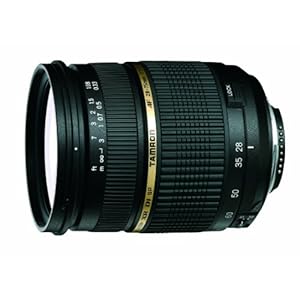
Today is the right time to get this as a gift. You are going to like this extremely popular Tamron AF 28-75mm f/2.8 SP XR Di LD Aspherical (IF) with Built-In AF Motor for Nikon Digital SLR Cameras and its slashed price. Don't miss it - get the Tamron AF 28-75mm f/2.8 SP XR Di LD Aspherical (IF) with Built-In AF Motor for Nikon Digital SLR Cameras here now!
Product Description
Style: Nikon
From the Manufacturer
This ground-breaking high-speed mid-range zoom is prized by pros and serious shooters for its fast F/2.8 constant aperture, evenness of illumination, and its outstanding imaging performance, and by all photographers for its compact size and reasonable weight that make it feel like an ordinary standard zoom. These admirable characteristics have been achieved by the use of special XR and LD glass, the efficient use of aspherical elements, and non-rotating internal-focus (IF) design. This remarkable zoom lens also focuses down to 0.33m (13”) (1:3.9 magnification) at all focal lengths for satisfying close-up performance and is compatible with APS-C and full-frame-format SLRs. Not surprisingly it is widely acclaimed as a classic.
SP70-300mm F/4-5.6 Di VC" src="http://g-ecx.images-amazon.com/images/G/01/ce/844/AF28-70mm_high_speed_zoom/Center1.jpg"
Worlds smallest ; lightest lensThe most compact and lightest in the history of fast zoom lenses. Thanks to the revolutionary downsizing "XR" technology employed by Tamron in the development of high-power zoom lenses such as the 28-200mm and 28-300mm, the dramatic compactness that makes this lens the world's smallest and lightest is achieved. Its compactness makes it look and feel like an ordinary standard zoom lens, yet the versatility that a fast constant maximum aperture offers will definitely reshape your photographic horizons. SP AF28-75mm F/2.8 XR Di Features Digitally Integrated (DI) Lenses for the Best Imaging PerformanceDi (Digitally Integrated Design) is a Tamron designation that applies to lenses that have been optimized for digital capture using advanced multi-coating techniques and optical designs that assure excellent image quality across the entire picture field. Because of these characteristics, Di lenses provide outstanding performance on cameras with full-frame and APS-C format sensors as well as on 35mm film. Low Dispersion (LD) Glass for Greater Lens Sharpness
Low Dispersion (LD) glass reduces chromatic aberrationLow dispersion (LD) glass elements in a lens help reduce chromatic aberration; the tendency of light of different colors to come to different points of focus at the image plane. Chromatic aberration reduces the sharpness of an image, but glass with an extremely lowdispersion index, has less of a tendency to separate (defract) a ray of light into a rainbow of colors. This characteristic allows the lens designer to effectively compensate for chromatic aberration at the center of the field (on axis), a particular problem at long focal lengths (the telephoto end of the zoom range), and for lateral chromatic aberration (towards the edges of the field) that often occurs at short focal lengths (the wide-angle end of the zoom range.) Super Performance (SP) for Discriminating ShootersTamron SP (Super Performance) series is a line of ultra-high-performance lenses designed and manufactured to the exacting specifications demanded by professionals and others who require the highest possible image quality. In creating SP lenses Tamron’s optical designers put their foremost priority on achieving superior performance parameters—they are all designed to a higher standard with little regard for cost constraints. As a result, Tamron lenses bearing the SP designation feature impressive and innovative designs that have established an enviable reputation for excellence among those knowledgeable photographers that demand the very best. Extra Refractive Index Glass (XR)
Special glass for better performance and more compact lens designsExtra Refractive Index (XR) glass can bend light rays at steeper angles, thereby decreasing the physical length of the lens while enhancing imaging performance by minimizing optical aberrations. This has allowed Tamron to develop a line of shorter, smaller-diameter, lighter lenses without sacrificing lens speed, and actually upgrading image quality compared to older designs. XR glass is costlier than conventional glass but it yields enhanced optical power distribution, making possible many of the outstanding and innovative lens designs that bear the XR designation. XR glass, with its superior light-bending power, makes it possible to design a short-barrel lens with the same light-gathering ability (aperture value) as a long-barrel lens—even with a smaller lens diameter. By using this principle Tamron has been able to shorten the length of the entire optical system and produce lighter, more compact lenses of the same speed, and also to provide greater zoom ranges in lenses that are much more convenient to carry by hand. Internal Focusing (IF) SystemInternal focusing provides numerous practical benefits to photographers including a non-rotating front filter ring that facilitates the positioning of polarizing and graduated filters, and more predictable handling because the lens length does not change during focusing. Even more important, Tamron’s Internal Focusing (IF) system provides a much closer minimum focusing distance (MFD) throughout its entire focusing range. In addition, IF improves optical performance by minimizing illumination loss at the corners of the image field, and helps to suppress other aberrations that become more troublesome at different focusing positions. Aspherical Lens Elements (ASL)
Aspherical Lens ElementTamron uses several hybrid Aspherical lens elements in many lenses bearing the Aspherical designation. These innovative optics allow us to achieve the ultimate in image quality, and at the same time produce lenses that offer remarkable zoom ranges in extraordinarily compact packages. By perfecting theses cutting-edge advances for series production, Tamron has advanced the state of optical design, and virtually eliminated spherical aberration and image distortion from the high-power-zoom series.Through the effective application of Hybrid Aspherical Technology, one lens element can take the place of multiple elements without compromising performance. This is what allows us to produce remarkably compact long-range lenses that deliver a uniformly high level of image quality at all focal lengths and apertures. Zoom Lock (ZL)Another original Tamron mechanical engineering concept is the Zoom Lock (ZL), a simple convenience feature that prevents undesired extension of the lens barrel when carrying the camera/lens unit on a neck strap.
The most compact and lightest in the history of fast zoom lenses. Thanks to the revolutionary downsizing "XR" technology employed by Tamron in the development of high-power zoom lenses such as the 28-200mm and 28-300mm, the dramatic compactness that makes this lens the world's smallest and lightest is achieved. Its compactness makes it look and feel like an ordinary standard zoom lens, yet the versatility that a fast constant maximum aperture offers will definitely reshape your photographic horizons.
Price : $499.00
You Save : $523.95 (51%)

Product Details
- Product Dimensions: 4 x 3 x 4 inches ; 12 ounces
- Shipping Weight: 2 pounds (View shipping rates and policies)
- Shipping: This item is also available for shipping to select countries outside the U.S.
- ASIN: B001955P8W
- Item model number: A09NII
Price : $499.00
You Save : $523.95 (51%)
Customer Reviews
I have never bought a non-Canon lens because I just love the look, feel, and optical quality of the Canon line particularly the L series lenses. But I kept reading glowing reviews about this lens. On multiple websites. So, I went out and took a look.
First impression: the build quality is not as good as a Canon L series lens. Duh! It costs about 1/4 as much for goodness sake. This is a plastic lens - not metal. But I must admit that the build quality was pretty darn good. Better, I think, than the Sigma lenses I've seen. Fit and finish was very nice and tight. I'd give the build quality a 4/5. Not bad. I figured I could live with it.
Next, I put the lens on my camera. I'd read reviews complaining about the speed of the focusing. It may not be quite as quick as my 200 f2.8 L series lens but it was pretty darn good and for my purposes, plenty fast. A 4.5/5
I'd read reviews complaining about the noise and the fact that the AF was not USM. I thought the AF worked very quietly. Not at all distracting and barely discernable. Noise - not an issue.
Then, I took pictures with the lens and I was absolutely floored! How in the world did Tamron manage to produce a lens that performed so well optically for such a reasonable price?! Beautiful contrast, excellent resolution, gorgeous colors, and extremely sharp, particularly above f2.8. But, f2.8 is very good as well.
Obviously the first comparison that comes to mind is between this lens and the Canon 24-70 f2.8 L. I would say, I kid you not, that this lens is in every respect optically the equal of the Canon or better than the Canon. I could not believe it.
I tested this lens directly against a brand new copy of the Canon 24-70 f2.8L. Method: I tested both lenses on a tripod F 2.8 and 8.0 28mm 50mm and 70mm. Target limestone wall 9.5 feet parallel to the sensor plane. Remote release employed. No mirror lockup. Center and all four corners were evaluated to my naked eye on a monitor using 100% crops. Both lenses were new copies received within the last 7 days.
The limestone wall lent itself perfectly to evaluating sharpness and subtle contrast and color rendition. There was enormous detail present in the wall with subtle colorations present.
Findings:
28MM F8: Tamron definitely sharper in the center and corners
28MM F2.8: Tamron definitely sharper in the center and corners
50MM F8: Tamron slightly sharper in the center and very slightly sharper in corners
50MM F2.8: Tamron slightly sharper in center and equal in corners.
70MM F2.8: Canon sharper in center and at corners. Incidentally noted was inability of Tamron to focus as sharply as I was able to achieve with manual focusing.
70MM F8: Tamron sharper in center with Canon slightly sharper in corners.
Some have said that there is less flare with the Canon, but if you use the lens hood that should not be a problem. I didn't notice excessive flare in my copy.
Admittedly there is significant copy to copy variation in both the Canon and the Tamron, but my findings convinced me that at 1/4 the price, and with the Tamron weighing 1 pound less than the Canon that the Tamron was the lens for me. Optically 5/5
I cannot recommend this lens highly enough. It is the first non-Canon lens I have owned and I am thrilled.
Let me start by saying I didn't want to like this lens. I've been a Canon lens purist since my first camera. I've always considered second party lenses to be inferior and not worth my time. Recently, however, I acquired another body (EOS 1). I wanted a dedicated walk around lens for it, since I'd been alternating my 24-70L between my digital and this new body. Unfortunately, my funds are a bit limited at them moment, so I wasn't able to purchase another 24-70L as I would have liked. So I began an extensive search for a lens that would fit my needs AND budget.
After a while, I started leaning toward the 28-105 f/3.5-4.5. However, although I got close to purchasing one several times, I just couldn't pull the trigger. It seemed good enough, but I just wasn't convinced. Then just by accident, I read a review of the Tamron. The review went on and on about the performance and sharpness of the lens. I thought it was all just hot air. Then I saw a second review that stated the same thing. I became intrigued. I started my research. I went to several different sources and a clear picture began to emerge: this is a lens that a lot of people really like. This is a lens that consistently gets compared to my beloved 24-70L, and consistently holds its own--or even out performs it. At first I thought it unfair to compare it to the 24-70L, but then I saw sample images. I saw sharpness tests. I was impressed.
So I took the plunge, and I'm so glad I did. As soon as it arrived, the first thing I noticed was that it did not feel like a cheap lens. I had expected it to be feather-light and almost flimsy. Instead, it feel substantial. It also came with a lens hood.
I threw it on my 400D and fired off some shots and took a look. I was very happy with the results. The color reproduction was great. And so was the sharpness. Just for my own edification, I set up my tripod and made some test shots with the Tamron and then the same shots with the 24-70L. The first go 'round was done at f/5.6. I made exposures at 28mm, 35mm, 50mm, and 70mm with each camera. I had a friend rename the files so I wouldn't know which shots came from which camera, so I couldn't claim bias either way. I then examined the shots. It didn't take nit-picky scrutiny to see the differences. After I selected the photos I found to be sharper in each group, my friend gave me the exif data on each one.
Here is what I found:
First Impression--At 25% magnification on my screen, all the photos looked fantastic. This puzzled me because I figured I'd be able to spot the 24-70L right away. I really couldn't tell the difference.
Then I zoomed in to 100% and the fun really began.
28mm--The difference in sharpness was very pronounced at this focal length. One photo was the clear winner, and that was the Tamron, particularly in center sharpness.
35mm--Again, one of the photos was a clear winner, and again it was the Tamron.
50mm--For the third time, the Tamron's sharpness outperformed the Canon. I was beginning to really develop an affinity for this little baby.
70mm--At this length, the photos were pretty comparable. I picked one, however, and, to my surprise, it was the Tamron once again.
-----
After these tests I felt like a heretic. I had preferred the Tamron lens over the Canon in each trial. Granted, there are more I need to do, from wide open to fully stopped down. But this initial test has made me very happy.
I have seen no evidence of CA so far, and given Tamron's claims, I would have been surprised if I had.
The AF is a touch on the loud side (no USM), but it works well and is accurate. A bit of noise from the AF is nothing to complain about when one sees the results in the photos.
It's not weather sealed like the 24-70L, but that is not as important to me as to someone who is out in extreme weather with some regularity.
Finally, given the fact that this lens is just a third of the price of the 24-70L, and given that I am so impressed with the results, I'd have to say this is one of the better purchases I've made in a long, long time.
I know all Tamron lenses do not perform this admirably, just like all Canons are not "L" class. However, I will certainly add them to my research when I have a new need for a lens.

No comments:
Post a Comment