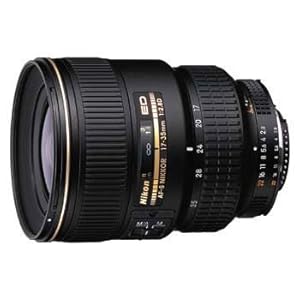
Right now you are searching for Nikon 17-35mm f/2.8D ED-IF AF-S Zoom Nikkor Lens for Nikon Digital SLR Cameras. Purchase this item and anything else you require in terms of all your needs. For secure and reliable service, shop right here at here.
Product Description
Manufacturer Description
Lens-making is an art--Nikon artisans craft Nikkor optics from the finest materials, taking pride in adding their intellect and technique to bring the world's finest lenses to life. They push the leading edge of lens-making in their effort to provide the "glass" that makes the world's greatest pictures.
AF Nikkor lenses work with Nikon SLRs for optimal performance, even the very latest. The 17-35mm f2.8D ED-IF AF-S Zoom Nikkor Lens is the standard lens for photojournalism and travel photography, perfect for use with a film or a digital SLR. It features a Silent Wave Motor, two types of aspherical lens (two molded-glass lenses and one hybrid), and two ED glass elements for higher optical performance, 11.02-inch closest focusing throughout the zoom range, M/A mode for quick switching between autofocus and manual focus operation, and nine-blade rounded diaphragm that achieves a natural blur for out-of-focus elements. The ED glass element reduces chromatic aberrations providing superior optical performance--even at maximum aperture. There is also no power drain when manually focusing.
ED glass: An essential element of Nikkor telephoto lensesNikon developed ED (Extra-low Dispersion) glass to enable the production of lenses that offer superior sharpness and color correction by minimizing chromatic aberration. Put simply, chromatic aberration is a type of image and color dispersion that occurs when light rays of varying wavelengths pass through optical glass. In the past, correcting this problem for telephoto lenses required special optical elements that offer anomalous dispersion characteristics--specifically calcium fluoride crystals. However, fluorite easily cracks and is sensitive to temperature changes that can adversely affect focusing by altering the lens' refractive index. So Nikon designers and engineers put their heads together and came up with ED glass, which offers all the benefits and none of the drawbacks of calcium fluorite-based glass. With this innovation, Nikon developed several types of ED glass suitable for various lenses. They deliver stunning sharpness and contrast even at their largest apertures. In this way, Nikkor's ED-series lenses exemplify Nikon's preeminence in lens innovation and performance.
Nikon Super Integrated Coating ensures exceptional performanceTo enhance the performance of its optical lens elements, Nikon employs an exclusive multilayer lens coating that helps reduce ghost and flare to a negligible level. Nikon Super Integrated Coating achieves a number of objectives, including minimized reflection in the wider wavelength range and superior color balance and reproduction. Nikon Super Integrated Coating is especially effective for lenses with a large number of elements, like our Zoom-Nikkors. Also, Nikon's multilayer coating process is tailored to the design of each particular lens. The number of coatings applied to each lens element is carefully calculated to match the lens type and glass used, and also to assure the uniform color balance that characterizes Nikkor lenses. This results in lenses that meet much higher standards than the rest of the industry.
Aspherical lens elementsNikon introduced the first photographic lens with aspherical lens elements in 1968. What sets them apart? Aspherical lenses virtually eliminate the problem of coma and other types of lens aberration--even when used at the widest aperture. They are particularly useful in correcting the distortion in wide-angle lenses. In addition, use of aspherical lenses contributes to a lighter and smaller lens design. Precision-ground aspherical lens elements are the finest expression of lens-crafting art, demanding extremely rigorous production standards. Hybrid lenses are made of a special plastic molded onto optical glass. Molded glass aspherical lenses are manufactured by molding a unique type of optical glass using a special metal die technique.
Internal FocusingImagine being able to focus a lens without it changing in size. Nikon's IF technology enables just that. All internal optical movement is limited to the interior of the non-extending lens barrel. This allows for a more compact, lightweight construction as well as a closer focusing distance. In addition, a smaller and lighter focusing lens group is employed to ensure faster focusing. The IF system is featured in most Nikkor telephoto and select Nikkor zoom lenses.
Distance informationD-type and G-type Nikkors relay subject-to-camera distance information to AF Nikon camera bodies. This then makes possible advances like 3D Matrix Metering and 3D Multi-Sensor Balanced Fill-Flash. Note: D-type and G-type Nikkors provide distance information to the following cameras: Auto exposure; F6, F5, F100, F90X, F80, F75, F70, F65, F60, F55, F50, Pronea S, Pronea 600i, D2 series, D1 series, D100 and D70s/D70. Flash control; F6, F5, F100, F90X, F80, F75, F70, D2 series, D1 series, D100 and D70s/D70.
Silent Wave MotorNikon's AF-S technology is yet another reason professional photographers like Nikkor telephoto lenses. AF-S Nikkors feature Nikon's SWM which converts "traveling waves" into rotational energy to focus the optics. This enables high-speed autofocusing that's extremely accurate and super quiet.
M/A modeAF-S Nikkors feature Nikon's exclusive M/A mode, that allows switching from autofocus to manual operation with virtually no time lag--even during AF servo operation and regardless of AF mode in use.
What's in the Box:Lens, 77mm snap-on front lens cap, rear lens cap LF-1, bayonet hood HB-23, hard case CL-76.
Wide-Angle Zoom Lens from UltraWide to Wide Angle / F2.8 Maximum Aperture
Price : $1,349.00

Product Details
- Item Weight: 1.6 pounds
- Shipping Weight: 4 pounds (View shipping rates and policies)
- Shipping: This item is also available for shipping to select countries outside the U.S.
- ASIN: B00005LEOS
- Item model number: 1960
Price : $1,349.00
Customer Reviews
This lens is widely held to be one of the best if not the best wide angle professional zoom lens for 35mm and Digital SLRs compatible with Nikon's lens system. I've had mine for about 6 months on a Nikon D-100 and have absolutely nothing I don't like about it. It's sharp from corner to corner at all zoom settings and any pincusion destortion is negligible even at 17mm f2.8. The AFS focusing motor is lightning fast and accurate. Filter size is 77mm, same as my Nikkor 70-200mm f/2.8G ED-IF AF-S VR lens. Since filters this size aren't cheap, it's nice to be able to share. This lens will support 35mm, APS, and DX format film and digital sensor sizes and comes with a 5-year warranty. If you want the best, and can afford it, you won't be sorry you purchased this lens.
This is a first-class professional quality lens. I am using it on Nikon F5, F100, and D200 bodies. I bought it in anticipation of purchasing an FX digital format successor to the D200/D300 DX-format cameras. It is extremely sharp from edge-to-edge, rendering crisp images with great color and contrast. Good low-light performance for natural people-pictures. On my film-based shoots, it is nothing short of spectacular. With digital, I am presently using DX-format cameras, so the focal-length range is reduced. But, when used with an FX-format digital, I expect equally exceptional results. This lens is considered both heavy and pricey by some. However, I find the weight promotes better stability with hand-held images. The price is right for what you get. I also like a depth of field indicator on the aperature ring for doing wide-ange shots employing hyper-focal distance techniques. You don't get this with the newer g-series lenses. If you can afford this lens and are going to go FX-format, buy it.

No comments:
Post a Comment